Lawn Care Calendar for Rock County, Wisconsin
Updated
Get a free quote
We reply with a price. Nothing is booked until you say yes.
Rather talk? Call (608) 530-1141 or text us.
Short answer
Part of Fertilization and Weed Control.
The dates the calendar hangs on
The Wisconsin State Climatology Office's Rock County profile, based on 1995 to 2024, puts the average last hard freeze (28 degrees) on April 10, the last freeze (32 degrees) on April 26, the first freeze on October 12 and the first hard freeze on October 23. The county averages 33.7 inches of precipitation a year, rising since 1950, and 76% of its 2-inch heavy-rain days fall between June and September (State Climatology Office, Rock County). Those are averages: a given year can run two weeks either way.
Month by month
| Month | What to do |
|---|---|
| March | Rake out winter debris once the ground is firm. Hold the fertilizer: the ground can still freeze, and Wisconsin law bans fertilizing frozen ground. |
| April | Average last hard freeze April 10, last freeze April 26. Spring cleanup and the first mow once the grass is growing. UW-Madison Extension advises against April fertilizing. |
| May | Fastest growth of the year: mowing can need twice a week to stay inside the one-third rule. Memorial Day feeding on a high-quality lawn. Janesville's spring bagged yard waste week. |
| June | Weekly mowing at 2.5 to 3.5 inches. Heavy-rain season begins; 2-inch rain days cluster from June to September. |
| July | Fourth of July feeding on a high-quality lawn. In a hot dry stretch, mow higher and less often; about 1 inch of water a week keeps a lawn green, or it can go dormant. |
| August | Plan the fall work: soil test if phosphorus is a question, and line up aeration and seed. |
| September | The most important month. Labor Day feeding (the single best time if a lawn gets only one), core aeration, and overseeding finished by early September. |
| October | Early October feeding. Average first freeze October 12, first hard freeze October 23. Leaves may go in Janesville's gutter from October 1. |
| November | Janesville loose leaf pickup November 9 to 20, 2026, bagged yard waste November 30 to December 4, 2026. Last mow, fall cleanup, and no fertilizer once the ground freezes. |
Feeding: the holiday schedule
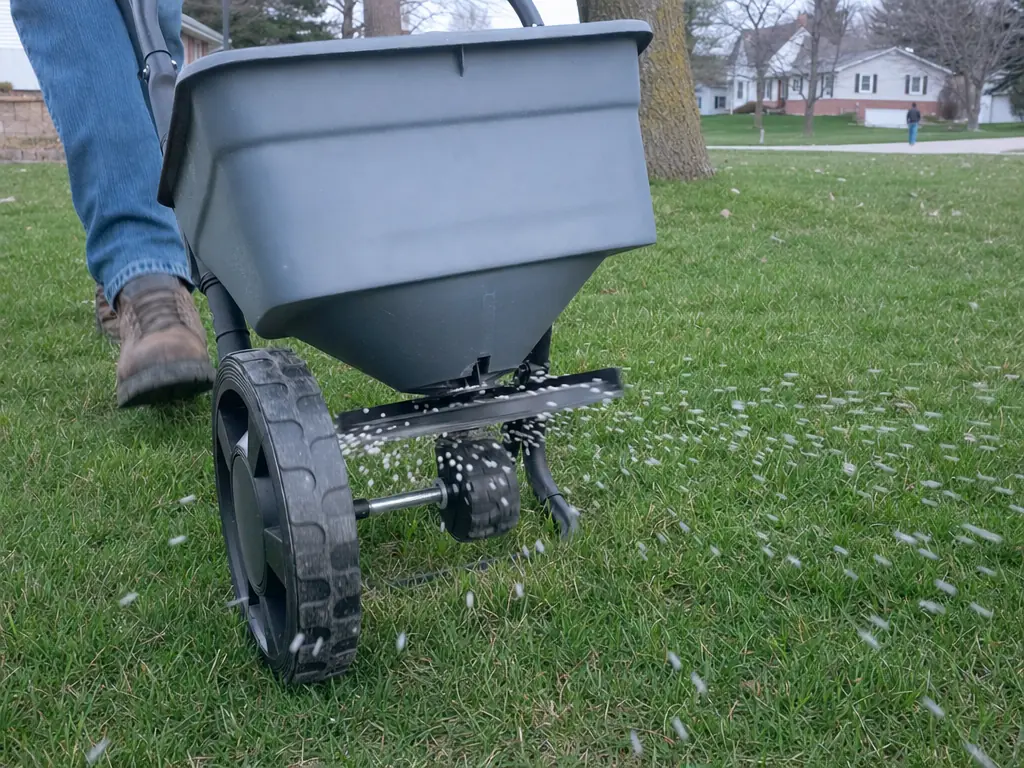
UW-Madison Extension's schedule for a high-quality lawn is Memorial Day, the Fourth of July, Labor Day and early October. A lawn that gets only one feeding should get it in early September, and April applications are best avoided (UW-Madison Extension, fertilizer timing). The average lawn needs about 3 pounds of nitrogen per 1,000 square feet a year, with a quarter to a half slow-release (UW-Madison Extension, Lawn Maintenance). Under Wisconsin Statute 94.643, no phosphorus on an established lawn without a recent soil test, and no fertilizer on frozen ground at either end of the season (Wis. Stat. 94.643).
Aerating and seeding: late summer, not spring
Extension recommends core aeration in the fall with adequate soil moisture, and overseeding done by early September so seedlings establish before hard freezes (UW-Madison Extension, aerating and overseeding). With a first freeze around October 12, that leaves roughly six weeks of growing for seed sown at the start of September. Details are on the aeration and overseeding page.
Mowing and water through the summer
Mow at 2.5 to 3.5 inches and never take more than a third of the blade. About 1 inch of water a week from rain and irrigation together keeps a lawn green, applied no more often than once a week and early in the morning to push roots deeper; a lawn left dry can go dormant and recover after about 10 days of enough water (UW-Madison Extension). Janesville publishes no lawn sprinkling restriction that we could find. Weekly mowing details are on lawn mowing.
What a full season costs
Weekly mowing from late April to late October is about 26 visits, or roughly $1,014 to $1,430 on a typical quarter-acre lot at $39 to $55 a cut. A fertilizer and weed control program adds $250 to $550 a season, core aeration $38 to $48, and a fall cleanup $190 to $806. Every source is on the lawn care cost page.
Sources: Wisconsin State Climatology Office, Rock County climate profile; UW-Madison Extension Horticulture, ideal timing for fertilizing lawns; UW-Madison Extension Horticulture, Lawn Maintenance (A3435); UW-Madison Extension Horticulture, aerating and overseeding lawns; Wisconsin Statutes 94.643, restrictions on phosphorus turf fertilizer; City of Janesville, fall loose leaf collection; City of Janesville, bagged yard waste collection (spring and fall)
Want a price for your own place?
Call, text, or send the form. You get a written price back before anything is scheduled.
Quick answers
When should I start mowing in Rock County?
When the grass is actively growing, usually after the average last freeze on April 26 (Wisconsin State Climatology Office, 1995-2024).
When is the last time to fertilize a lawn in Wisconsin?
UW-Madison Extension's last feeding is early October. Wisconsin law bans fertilizing frozen ground, so the season ends before the ground freezes.
When should I overseed in Wisconsin?
By early September, after core aeration, so seedlings establish before hard freezes. Rock County's average first hard freeze is October 23.
How much should I water my lawn in Wisconsin?
About 1 inch a week from rain and irrigation together, no more often than once a week, early in the morning (UW-Madison Extension).
Rather not do the yard yourself?
Tell us the address, the lot size and what you want done. We reply with a price before the first visit.